Major Trend Lines in the Jungle: The Ancient Paths
In the wild jungle of the markets, major trend lines are like the ancient trails carved by generations of animals—paths so well-trodden that even the fiercest beasts pause when they reach them.
What Are Major Trend Lines?
Major support lines are the jungle’s deepest valleys—places where the price, like a thirsty animal, comes to drink and rest. These levels have stopped the market’s fall many times over the years, acting as a strong “floor” where buyers gather their courage and push prices back up.

Major resistance lines are the highest cliffs or impassable walls—zones where the price, like a troop of monkeys, tries to climb but is forced back by the sheer height and the strength of the opposing tribe. These “ceilings” have turned back rallies time and again, sometimes only once every few years.

Why Are They So Important?
• These lines are called major because they are formed over long periods—sometimes only touched every 2–5 years. When the price approaches these levels, the entire jungle holds its breath: will the herd break through, or will the old path hold strong once again?
• The more times a price bounces off these levels, the more legendary they become—like a watering hole that every animal knows but only visits in times of drought or plenty.
How to Spot These Ancient Paths
• Look for lines that connect multiple swing highs or lows over many years—the more touches, the more “major” the line.
• Check the time frame: The longer the period (monthly or yearly charts), the more significant the trend line.
• Watch for reactions: When price nears these lines, expect big moves—either a powerful reversal or a dramatic breakout as the jungle’s balance shifts.
In summary:
Major trend lines are the jungle’s ancient trails—rarely touched, always respected, and critical to every animal’s survival. Whether you’re a gorilla, giraffe, or elephant, knowing where these lines lie can help you navigate the wilds of the market with confidence and wisdom.
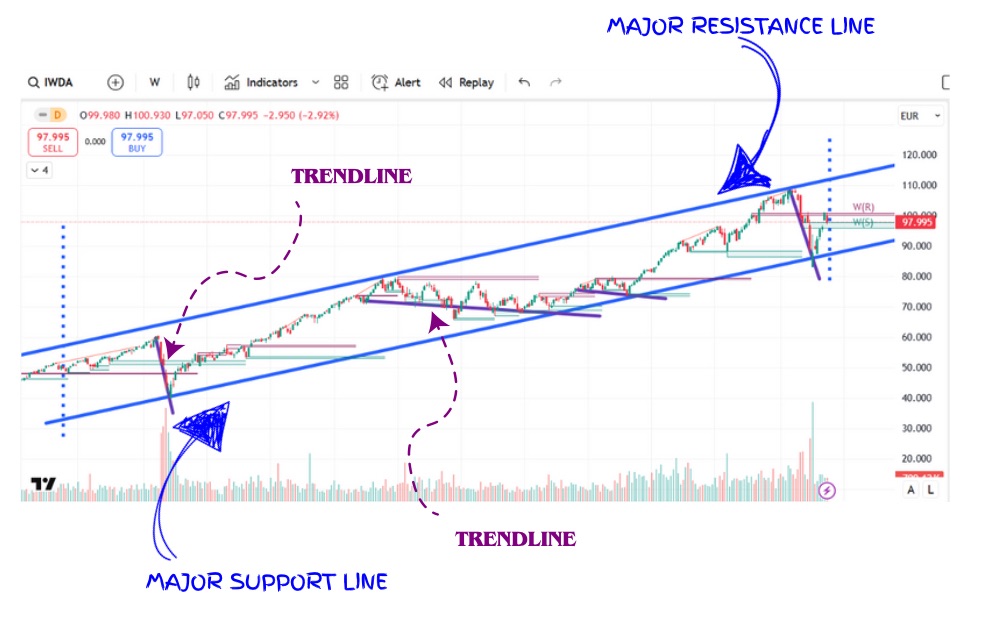
“Real World” Examples
ETF world (IWDA): May 2019 – May 2025
Limit Orders: Setting Your Banana Traps
Imagine the Gorilla in our jungle wants to buy bananas, but only if the price drops to a bargain. Right now, bananas are 10 coins each, but the Gorilla thinks they might get cheaper soon.
The Gorilla sets a buy limit order:
He tells the banana market, “I want to buy 10 bananas, but only if the price falls to 7 coins or less.”
The Gorilla then enjoys his day and doesn’t need to watch the market constantly.
What happens next?
If the banana price drops to 7 coins or lower, the Gorilla’s order is automatically filled, and he gets his bananas at the price he wanted.
If the price never drops to 7 coins, the Gorilla’s order just sitts there, unfilled, and he doesn’t overpay for bananas.
This is how the Gorilla (our active investor) uses limit orders: he decides in advance what price is a good deal, places his order and waits patiently – never letting the snake of greed push him into buying too soon or at a bad price.
In summary
A limit order lets you buy (or sell) only at the price you choose or better. For the Gorilla, it’s like setting a banana trap at just the right spot – it only gets the bananas if they fall into his price range!
If you want to learn more you can checkout the platform babypips – https://www.babypips.com/forexpedia/limit-order.

 Welcome to the espresso way of investing!
Leave a comment